


How to run a quality improvement project in healthcare
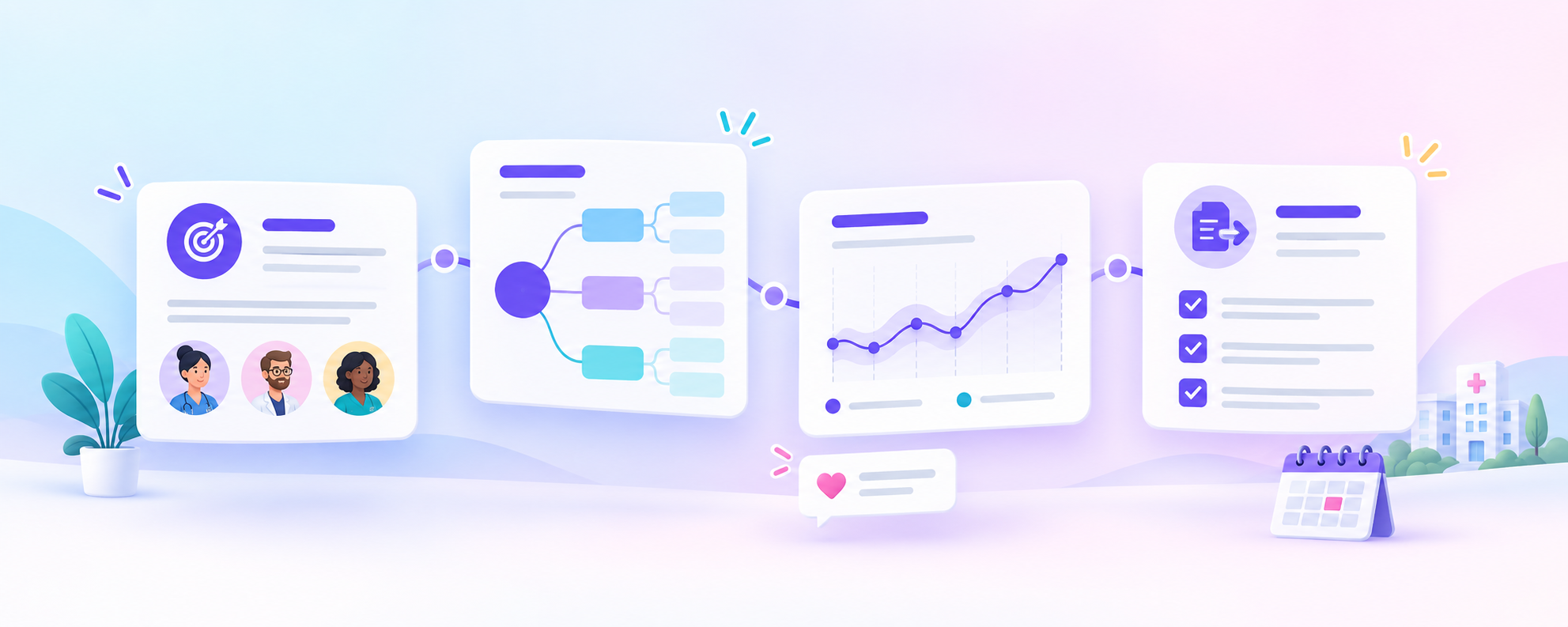
Run a healthcare quality improvement (QI) project by defining the problem, planning small tests, reviewing evidence and handing over what works. This guide takes you through four stages, with practical steps, healthcare examples and supporting articles.
1. Setup · 2. Planning · 3. Evidence · 4. Close-out
Planning, testing and learning repeat throughout a project. Use the stages to organise your work, and return to earlier decisions as you learn.
1. Setup
Project idea
Start with a clear problem, a manageable scope and the people who can help change the process. Agree why the project matters before choosing a solution.
- Identify the problem using service data and patient or staff experience.
- Define the setting, population and boundaries of the work.
- Agree a project lead, sponsor and the time the team will need.
Healthcare example — illustrative: An outpatient team wants to reduce long waits. It starts with one clinic and maps the journey from arrival to consultation, involving reception staff, clinicians and patient representatives.
Your output: An agreed project brief describing the problem, scope, team and intended benefit.
Explore Simana project-management tools to connect goals, responsibilities and project activity.
2. Planning
Improvement team
Bring together people who understand the process, can interpret the data and can make decisions. Include patients or service users and agree who owns each part of the work.
Identify a project lead, sponsor, clinical or service expertise and support for measurement. Agree responsibilities, protected time and a regular review meeting before testing changes.
Aim statement
Turn the problem into a measurable aim, agree how you will recognise improvement and plan small tests of change.
- Set a specific aim with a baseline, target and deadline.
- Choose outcome, process and balancing measures.
- Plan your first PDSA test and record your prediction.
Healthcare example — illustrative: The outpatient clinic aims to reduce median arrival-to-consultation time from 40 to 30 minutes within six months. It plans to test a revised check-in process while monitoring staff workload.
Your output: A project plan connecting the aim, measures, change ideas and first tests.
Explore PDSA cycles in Simana to plan tests, assign activities and capture learning.
Measurement plan
Define each measure, its data source, collection frequency and owner. Decide how to display results over time and check for unintended consequences.
For the illustrative clinic project, track waiting time as an outcome, use of the revised check-in process as a process measure, and staff workload as a balancing measure. Record clear definitions so collection is consistent.
Use the linked measurement-plan article to work through the fields your plan needs.
3. Evidence
Design & test changes
Test a change on a small scale using Plan–Do–Study–Act (PDSA). Record your prediction, what happened and what the team learned. Decide what to adopt, adapt or abandon in the next cycle.
A successful small test is a starting point for further learning. Test under different conditions before wider implementation, and choose analysis appropriate to the data available.
Data collection
Collect and review evidence throughout the project. Use data and the experience of patients and staff to understand what is changing and guide your next decision.
- Collect consistent data before, during and after tests.
- Review results over time alongside PDSA learning.
- Record decisions, limitations and unexpected effects.
Healthcare example — illustrative: The clinic plots waiting times over time and marks when each test began. It reviews the chart alongside patient feedback and staff workload before extending a test. A change in the chart alone does not establish what caused it.
Your output: An evidence record linking measures, tests, learning and decisions.
Explore charting in Simana to display data and annotate key events.
Maintain momentum
Use regular reviews to examine the evidence, remove barriers and agree the next actions. Give each action an owner and a date, and recognise learning as well as results.
A useful agenda is: what changed in the measures; what the latest test taught us; what is blocking progress; and what we will do next. Escalate problems that need sponsor support.
4. Close-out
Implementation
Close the project when its results and next steps are understood. Where tested changes are ready for routine practice, agree the handover and how performance will be monitored.
- Review results against the aim, including limitations.
- Agree ownership, training, resources and ongoing monitoring.
- Capture learning and complete the final project report.
Healthcare example — illustrative: If the clinic’s tests support adoption, the team documents the revised process and agrees a service owner and review schedule. Its final report records results and learning, including changes that did not work.
Your output: An implementation plan, accepted handover and final report. Agree what happens if performance deteriorates.
Explore project oversight in Simana to coordinate responsibilities and approvals.
Close out
Capture what the team achieved and learned, whether the aim was met, partly met or the work stopped. Confirm handover responsibilities and make the report available for others to learn from.
Your close-out report should include the original aim, measures and results over time, changes tested, limitations, lessons and next steps. Agree sign-off with the sponsor and preserve the project evidence according to local requirements.