


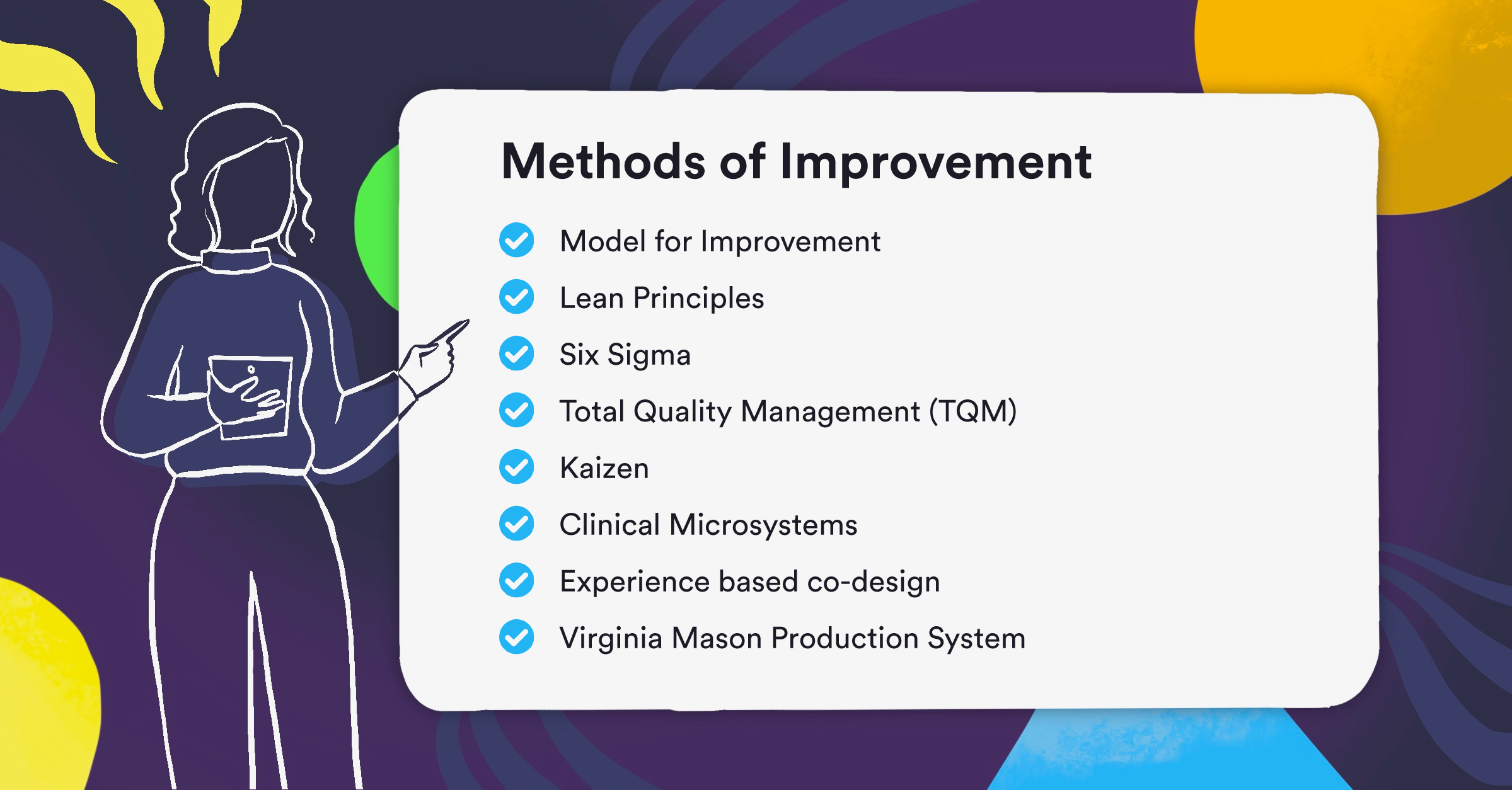
Improvement Methods
Model for Improvement
The Model for Improvement is a simple yet powerful framework for driving change. It uses three fundamental questions: What are we trying to accomplish? How will we know that a change is an improvement? What changes can we make that will result in improvement? These questions are addressed through the Plan-Do-Study-Act (PDSA) cycle, which allows for iterative testing and refinement of changes in a rapid and structured way.
Lean
Rooted in manufacturing principles, Lean focuses on eliminating waste and maximising value from the patient's perspective. It involves identifying and removing unnecessary steps, delays, and defects in processes. Tools like value stream mapping, 5S (Sort, Set in Order, Shine, Standardise, Sustain), and kanban are used to streamline workflows, reduce costs, and improve efficiency. The core principle is to do more with less, focusing on what truly adds value for the patient.
Six Sigma
A data-driven methodology focused on reducing variability and defects in processes. It employs a structured approach called DMAIC (Define, Measure, Analyse, Improve, Control) to systematically identify and eliminate the root causes of errors. Six Sigma relies heavily on statistical tools and techniques to measure process performance, analyse the causes of defects, and implement solutions that minimise variation and improve quality.
Total Quality Management
TQM is a management philosophy centred on continuous improvement and customer satisfaction. It emphasises the involvement of all members of an organisation in improving processes, products, services, and the culture in which they work. TQM fosters a culture of quality, teamwork, and employee empowerment, with a strong focus on data-driven decision-making and continuous learning.
Kaizen
Kaizen is a Japanese term which means "continuous improvement" or "change for the better." Kaizen is a philosophy that emphasises small, incremental changes made consistently over time to achieve significant overall improvements. It encourages all employees to identify and implement small improvements in their daily work, fostering a culture of continuous learning and problem-solving at all levels.
Clinical microsystems
Clinical microsystems are an improvement method that recognises that healthcare delivery is primarily performed within small, complex adaptive systems, such as a ward, clinic, or team. It focuses on understanding and improving these microsystems by empowering frontline staff to identify problems, test solutions, and continuously learn. It emphasises the importance of strong leadership, strong communication, and a patient-centred approach to care.
Experience based co-design
The experience based co-design is a patient-centred approach that actively involves patients, families, and staff in the design and improvement of healthcare services. It uses qualitative research methods, such as interviews and observations, to understand the patient experience and identify areas for improvement. EBCD then brings these stakeholders together to co-design solutions that address the identified needs and concerns.
Virginia Mason Production System
The Virginia Mason Production System (VMPS) is a comprehensive management system based on the Toyota Production System (TPS). It aims to bring continuous improvement through the elimination of waste, standardisation of processes, and development of a culture of problem-solving. VMPS uses tools like value stream mapping, huddle boards, and the "sensei" approach (mentorship) to support continuous improvement efforts and create a more efficient and patient-centred system.
Choosing improvement method
We’ve been looking at a wide range of improvement methods, and whether you have already decided which method you might use or if you've identified something in your department that is either inefficient, or not quite right - we hope this blog will help you choose the right Quality Improvement (QI) methodology for you. We take a look at the common improvement methods, Model for Improvement, Lean and Six Sigma and how you can work towards a ‘culture of continuous improvement’.
Audit & research
Audit and research are crucial components of quality improvement, enabling organisations to monitor their performance, identify areas for improvement, and implement evidence-based interventions to drive positive change. Find out more about which areas of research and audit can help with and support your QI projects, how exactly they work and when it’s best to use QI or use it in conjunction with other methods - such as audit or research - to deliver better care and outcomes for patients.
The difference between audit and research in quality improvement
In this blog we are going to look at the difference between audit and research in Quality Improvement (QI) and how these methodologies can work together in the quality space. We’re going to see which areas o...
Suzie Creighton
01 Sep 2022